Datatruck — a new operating system for logistics: how a startup with Uzbek roots is transforming the U.S. market
IT Park Uzbekistan spoke with Datatruck founder Shokhrukh Rakhmanov about why transportation companies need a unified TMS, how AI eliminates manual work, and why the development team is based in Uzbekistan.
Datatruck is a next-generation transportation management system (TMS) — an operating system for the freight industry that enables companies to manage shipments, documents, payments, and financial reporting within a single platform. Its core value lies in reducing financial losses and costs, ensuring full transparency across the entire transportation process, and increasing overall profitability.

The company’s primary revenue stream comes from paid subscriptions to the Datatruck platform. In addition, the startup offers paid AI-powered modules such as AI Updater, which automates calls and status updates for brokers and drivers, and Fintruck, a financial management tool that allows companies to track income and expenses, generate reports, and plan financial activities. These tools help clients save time and money while significantly reducing human error.
Currently, Datatruck works with more than 100 partners in the United States and has integrations with over 9,000 banks.
How it all started
Before launching Datatruck, I earned an MBA from the University of Rochester. I spent more than 10 years working in financial management and audit, both in public companies and at PwC and investment funds. While working closely with logistics companies in the U.S. and analyzing their financial reports and operational processes, I repeatedly encountered the same issue: manual workflows lead to losses of money, time, and growth opportunities.
Delayed reconciliations, document approvals, and the lack of financial transparency and analytics are major challenges across the transportation industry. In some cases, individual companies were losing up to $100,000 per year.
These observations — combined with five months of deep reflection on the problem and potential solutions — led me to design a logistics platform that became the foundation of Datatruck. I could clearly see where money was being lost and understood what solutions the market actually needed. This is how the idea of a platform that unifies finance, analytics, and operations into a single product was born — without requiring additional resources or manpower. It allowed not only large players but also small carriers to operate at an entirely new level.
Initially, we expected our product to appeal primarily to small companies. However, we were surprised to see strong interest from large enterprises as well — especially those tired of outdated TMS and legacy systems. We officially launched the company in September 2022 and made our first sales by January 2023.
How much it cost
We raised $200,000 from IT Park Ventures, $300,000 from Aloqa Ventures, and $100,000 from Domino Ventures. Later, Silkroad Angels Club joined as investors with an additional $170,000.
These investments allowed us not only to expand financially, but also to benefit from expert support and valuable industry connections. At the moment, we are in discussions with several international venture funds and plan to raise another round to scale further across North America.
The funds were allocated across several key areas. First, product development — including new AI modules, bank integrations, and strategic partnerships within the freight market. Second, marketing and sales, where we strengthened the team and expanded our market reach to drive leadership, not just growth. Part of the investment was also directed toward building the Datatruck brand in the U.S. and doubling the number of clients still relying on outdated TMS solutions. Finally, we invested heavily in optimizing the product architecture for scalability.
We were able to attract investment thanks to a strong engineering team, a solution that addresses real market pain points, and rapid organic growth without heavy marketing spend. Venture funds also support us through mentorship and access to networks, accelerating partnerships and expansion.
In the next round, we will focus on two priorities: expanding AI functionality and strengthening our position in the U.S. market through aggressive marketing. Our strategic goal is to attract enterprise-level fleets — companies operating hundreds or thousands of trucks. For these players, automation, engineering maturity, financial transparency, and scalable integrations are critical — and this is where Datatruck aims to lead.
Entering the U.S. market
The U.S. is the largest freight market in the world, valued at over $1 trillion. We identified a clear gap between the pace of technological innovation and the low level of tech adoption among trucking companies — especially in financial operations.
During our market research, nearly all carriers admitted to relying on dozens of Excel spreadsheets and performing bank reconciliations manually, often without tracking unit economics.

Speed is critical in logistics. This became a clear signal that the market was ready for digital transformation — particularly in financial and operational management. This need became even more evident during the ongoing industry crisis, now lasting more than three years.
One of the biggest problems in U.S. freight logistics is system fragmentation. Due to deregulation, the market became inefficient at solving these issues. Companies are forced to use 10–20 disconnected tools that don’t communicate with each other.
The second major issue is the lack of financial transparency and literacy. Many owners simply don’t know how much profit each truck generates or how their margins are formed.
I believe that within three years, automated communication and document workflows will become an industry standard. AI already enables full process automation today. In the future, self-driving trucks will also become a reality — and we are already building solutions that position Datatruck as the “operating system of the future” for carriers.
We plan to expand into Canada and Mexico through pilot projects with existing clients operating in those markets. This allows us to scale gradually while maintaining unified standards.
North America remains our top priority. Europe is a potential next step. While we currently do not plan to expand into the CIS or the Middle East, we do see growing demand for financial transparency tools in these regions and are evaluating opportunities in the mid-term.
From subscription to full integration
After registration, each client is assigned a Customer Success Manager who helps configure the system, migrate data, integrate telematics and GPS, set up factoring services, and more.
We also conduct team-wide training sessions. Unlike many competitors, we never leave clients alone with the software. Within three weeks, most clients say they can’t imagine operating without Datatruck. Full integration typically takes one to three weeks, depending on company size and complexity.
TruckGPT, Datatruck’s AI module, automatically processes dozens of logistics documents — including invoices, driver licenses, registrations, BOLs, PODs, DOT inspections, and more. It eliminates routine data entry, reduces errors, and accelerates document workflows.

TruckGPT is part of a broader AI ecosystem. AI automates broker and driver communication, analyzes route profitability, optimizes load booking, and ensures financial transparency through intelligent transaction categorization and receipt matching. Together, these tools form a unified intelligent layer across all logistics processes.
That’s why we describe Datatruck as an AI-native platform. We have an in-house AI development team, which gives us independence, flexibility, and the ability to deliver cutting-edge solutions tailored to client needs.
Who uses Datatruck
We began by serving small and mid-sized fleets (10–100 trucks), helping them move away from Excel and outdated systems. Today, our focus is increasingly on enterprise clients operating hundreds or thousands of trucks.
Datatruck partners with over 100 U.S.-based freight companies and integrates fuel providers, toll systems, truck geolocation, factoring companies, ELD services, and more. Soon, we plan to expand integrations in fuel payments, insurance, and compliance services.
Integrating with over 9,000 banks required standardizing diverse data formats. To ensure security, Datatruck passed a SOC 2 audit and is now recognized as a globally certified platform. We use AES-256 encryption, read-only bank access, two-factor authentication, and the highest data protection standards.
Client data security is our top priority.
The potential of Uzbekistan
Uzbekistan is rapidly becoming a hub for IT talent. Our core development team — responsible for architecture, infrastructure, AI, and integrations — is based here. This is not auxiliary work; it is the heart of the product.

Combining the U.S. market with Uzbek engineering talent makes Datatruck flexible and highly competitive.
Today, our team includes more than 50 professionals working across six countries. Operations are led from the U.S., while all development is done in Uzbekistan.
Our culture is built on respect for people and appreciation of all forms of work — whether you are a fleet owner or a truck driver. We value adaptability, transparency, responsibility, and innovation.
Who Is Behind Datatruck
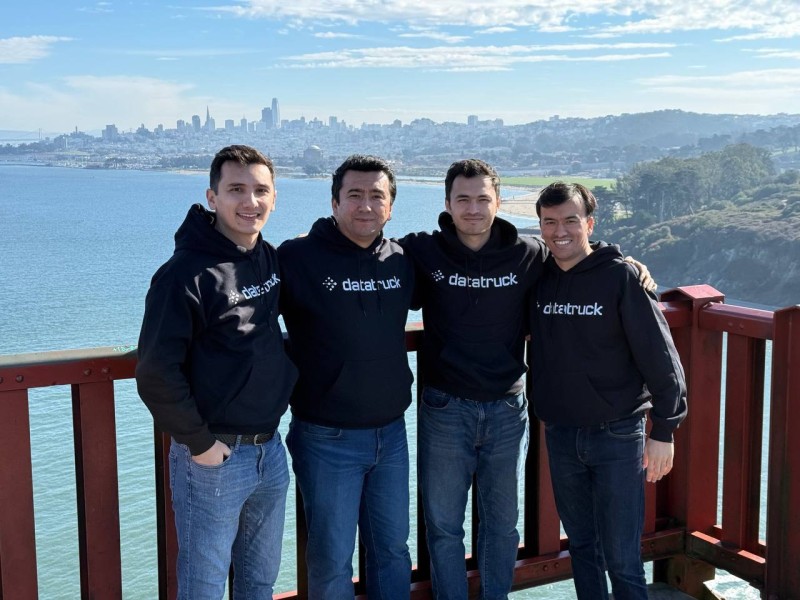
Today, our team consists of more than 50 highly qualified professionals working across six countries, including the United States, several European countries, and Uzbekistan. Our core operational activities are based in the U.S., while all product development is carried out in Uzbekistan.

Thanks to our roots and traditions, Datatruck has built a culture founded on respect for people and appreciation of every kind of work—whether you are the owner of a logistics company or a truck driver. We know how to operate with limited resources and, most importantly, how to adapt to rapidly changing realities.
Fast adaptation and flexibility are the key principles of how we work. We are able to respond quickly to challenges and find non-standard solutions. We use Uzbekistan’s strong IT school as our foundation, transforming local expertise into a global product capable of competing on the world stage.
Datatruck is built on the principles of transparency, accountability, and innovation. A true virtual bridge exists between our offices: the U.S. office identifies new trends and market needs, while the development team in Uzbekistan quickly turns these ideas into ready-to-use solutions. This exchange allows us to remain flexible, stay ahead of competitors, and feel like one unified team despite the distance.
Above all, I value honesty, responsibility, and initiative in my employees. Honesty helps build trust within the team, responsibility ensures tasks are completed with high quality and on time, and initiative drives growth and process improvement. In addition, teamwork skills and a constant desire to learn and grow are extremely important.
At the moment, we are actively looking for engineers, AI specialists, Customer Success Managers, and Project Managers. Yes, we are open to talents from Uzbekistan as well as from other countries. You can apply via the link.
Challenges
The most serious challenges were related to earning trust in a conservative industry where carriers are used to working the old way—with spreadsheets and manual processes. Another major challenge was building a stable team capable of developing a product at global standards while simultaneously adapting quickly to market needs. There were also technical difficulties, including integrations with telematics systems, banks, and accounting platforms. However, these very challenges helped us form a strong and reliable team that turns difficulties into a competitive advantage.

Advice for Early-Stage Startups
- Know and consider your customers’ needs in order to offer them the best solution. Communicate with customers from day one to understand their real problems, and build your product around them—not around your own assumptions.
- Develop adaptability. Startups live in a constant state of change—those who learn faster and adapt more quickly are the ones who win.
- Learn how to sell. Even the best product will not succeed if you cannot explain its value and importance to the customer. Sales are not just about numbers; above all, they are about building trust-based, long-term, and mutually beneficial relationships with clients.
Plans for the Future
Our goal is to make Datatruck a leading platform in the freight transportation industry and to turn it into the first U.S.-built Uzbek “unicorn” startup. By “unicorn,” we mean a technology company valued at over $1 billion—a rare and symbolic milestone reached by only a small fraction of startups worldwide. For us, this is not only about valuation, but also about recognition that we have built a truly in-demand product with a sustainable business model. We want to show that a startup with Uzbek roots can successfully compete in the world’s largest market and inspire the next generation of entrepreneurs in Uzbekistan.
2026-01-23